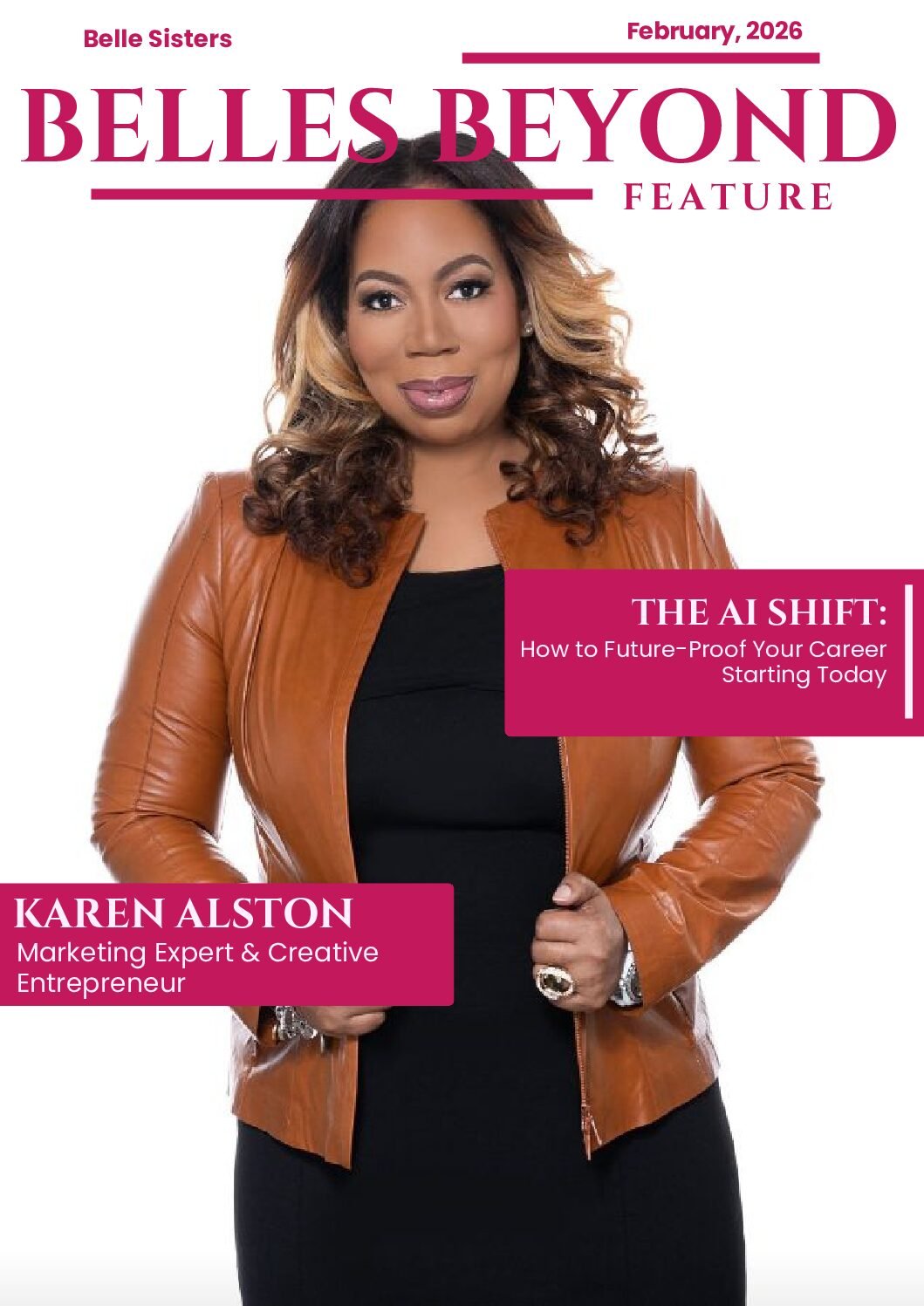
Belle Sisters: Hello everyone, and welcome again to Belle’s Beyond, the podcast by Belle Sisters. Today, I’m joined by Karen, who is in a season of intentional reinvention. She’s a leader currently applying her lived experience, strategic insight, and hard-earned wisdom to what comes next. She speaks candidly about growth, burnout, pivoting, and self-trust. After listening to Karen, I’m confident you’ll walk away with both perspective and practical frameworks for evolving without apology.
Hello, Karen.
Karen: Hello! How are you?
Belle Sisters: I’m doing amazing. How are you?
Karen: I’m good. I’m here in very cold Washington, D.C. The storm is not doing anyone any favors these days.
Belle Sisters: Thank you so much for joining us, Karen. You’re a leader who has pivoted into AI. I’d love to understand how that happened. How did you realize you wanted to move into AI? What drew you to it, and how has that transition been for you? Tell us about your journey.
Karen: First of all, I believe that no matter the hardships of the journey, God directs our steps.
I was a Chief Marketing Officer working in the nonprofit space. I had a great job and made good money. In 2023, maybe it was 2024, when ChatGPT 3.5 came out, I signed up immediately and started playing with it. If you remember when it first launched, it wasn’t great.
But I remember sitting there, thinking about my role, the vendors I hired, and the teams supporting marketing efforts. I thought, “This is a threat.” If this technology takes off, what happens to marketers and creatives who build and sell ideas? So I started learning and experimenting.
Then, at the end of 2024, right after the election and around the holidays, my company went out of business. It was heartbreaking. It was traumatic. Anyone who has lost a job knows, you go through the five stages of grief.
Living in Washington, D.C., during that time, people were losing contracts left and right. It was depressing. I had a choice: stay depressed or do something. Since I’d already been exploring AI, I decided to learn more about the industry disrupting marketing and creative work.
One class led to another. I earned certificates. Suddenly, an entire ecosystem opened up. I was recommended for programs, added to Slack communities, and introduced to opportunities before they were publicly announced.
Looking back, had I stayed in my job, I wouldn’t be here. I wouldn’t have had the time to study. As difficult as 2025 was, it has also been one of my greatest blessings. I feel like a salamander that went through fire and came out on the other side to abundance and opportunity.
Belle Sisters: That’s incredibly inspiring. You were an early adopter. Even when ChatGPT wasn’t impressive, you saw what it could become. Instead of retreating in fear, you leaned in and prepared.
And I resonate with the contract losses you mentioned. Last year, my business experienced cancellations due to policy changes. It was a trying season. So I truly admire how you navigated it.
Karen: I want to be clear, I have the scars. I was depressed for a good three months. I assumed finding another job would take two or three months. I had experience, education, and a strong network. I thought it would be easy. It wasn’t.
Friends of mine lost six- and seven-figure contracts. We were all grieving in different ways. But because I was studying AI, I realized this was just the first wave. More disruption was coming.
I couldn’t stay depressed. I had to pivot. In marketing especially, AI will significantly reshape the field. I had to figure out where I fit so I could continue to work and add value.
Belle Sisters: Where would you say you are now in that journey?
Karen: I’m still learning, but I’m in a very different place. Opportunities are discussed in private communities before they ever reach LinkedIn. I’m being encouraged to apply for fellowships. Doors are opening that I never would have considered before.
And I know that without the pain, I wouldn’t be here.
Belle Sisters: For a woman listening who may be in the same position you were in a year ago, where should she start?
Karen: First, I’m going to be more public about my process, on Instagram, LinkedIn, YouTube, so people can see the journey in real time.
Second, I’ll continue speaking on platforms like this.
Practically speaking, look at your field. What tools do you need to learn? What will your industry look like in three to five years? Some roles will disappear. Others will evolve.
For example, traditional corporate video production may decline because AI avatars can deliver scripts. But that creates opportunities for AI-driven production across global markets. You have to think creatively about expanding your services.
And let’s be honest, some fields won’t be touched immediately. They just may not be glamorous. Opening a coffee shop, a dry cleaner, or a hair salon may not sound prestigious, but those businesses provide stability. AI won’t replace human touchpoints easily. Trades like plumbing, HVAC, and construction will remain relevant for quite some time.
Belle Sisters: That’s powerful, stability over prestige.
You also mentioned surgeons potentially being impacted. That surprised me.
Karen: People don’t think about it. But look at where investment dollars are going: AI, robotics, autonomous systems, data centers. Robotic surgery with near-perfect accuracy is being developed. Younger generations may prefer precision over tradition.
This isn’t just a tool like the internet. It’s more like the Industrial Revolution. We’re shifting from professional service jobs toward a new labor ecosystem.
Belle Sisters: So upskilling becomes critical?
Karen: Absolutely. And I would tell an 18-year-old today that they may change professions three or four times in their lifetime. Technology will keep advancing. Humans have limits. Computers don’t sleep. They replicate tasks infinitely.
For someone in their mid-20s to mid-30s, I’d advise developing a second skill, something hands-on and monetizable. A skill you can rely on if your primary job changes. Whether it’s braiding hair, bartending, makeup artistry, building something with your hands, have an alternative income stream.
Belle Sisters: I love that. It’s practical and empowering.
Now, how did this entire experience reshape you as a woman?
Karen: It gave me clarity and stripped away fear. When you lose a big title, you discover who’s truly in your corner. Some people disappear. Others become angels.
Once I came out of depression, I realized the shift was happening whether I liked it or not. I could resist or adapt. I chose to listen and learn. I reduced distractions. I listen to podcasts daily. I applied for a fully funded fellowship in London, something I never would have done before. Doors are opening because I’m paying attention and staying curious.
The hardest part was mourning, not just the job, but my identity. I had to ask, “Who am I without that title?” That was the work.
Now I know: I’m still talented, still worthy, with or without a title. That clarity is priceless.
Belle Sisters: That is such a powerful note to end on. You are worthy, whether you have or don’t have the title.
Karen, thank you for your honesty, your wisdom, and your generosity in sharing your journey. This conversation is filled with insight and courage, and I know so many women will find strength in your story.